Introduction
As a part of my time at Wofford College, I spent Summer 2022 working closely with an interdisciplinary team of researchers across multiple disciplines including Anthropology and Sociology, Environmental Sciences, and Modern Languages and Cultures. This project bridged gaps between the academic researchers, government officials, and community leaders and members. The end result was Spartanburg County pledging $1 million in cleanup efforts for abandoned and condemned properties.
The study came from residents in the Una, Saxon, and Arcadia neighborhoods, historic industrial communities of Spartanburg. As the mills closed, many residents felt like the government forgot about them. Some believed the government was not doing their part in providing essential government services in their area. Therefore, the U.S.A. neighborhood committee was formed with a mission to address this injustice. Wofford students and faculty formed a partnership with the group to assist in community engagement, interviews, and data analysis.
The guiding question of our study was to find if there is an unequal distribution of abandoned and condemned homes in the Una, Saxon, and Arcadia neighborhoods in Spartanburg, SC.
Methods
Data Collection Challenges:
- The research focuses on condemned and abandoned houses, but abandoned properties lack a standardized definition.
- News coverage and public perception sometimes label properties as abandoned when they are not officially condemned.
- To ensure consistency, the study focuses on condemned houses, as they are officially recorded and enforced by local governments.
- Consultation with Jamie Nelson, Spartanburg County’s chief enforcement officer, provided insight into the condemnation process.
Data Analysis:
- Residents in Una, Saxon, and Arcadia expressed concerns about a high number of condemned and abandoned houses.
- The study aims to statistically assess whether these neighborhoods have a disproportionate number of condemned properties.
- Comparing these neighborhoods to the city of Spartanburg requires additional external data for a comprehensive study.
Mapping and Findings:
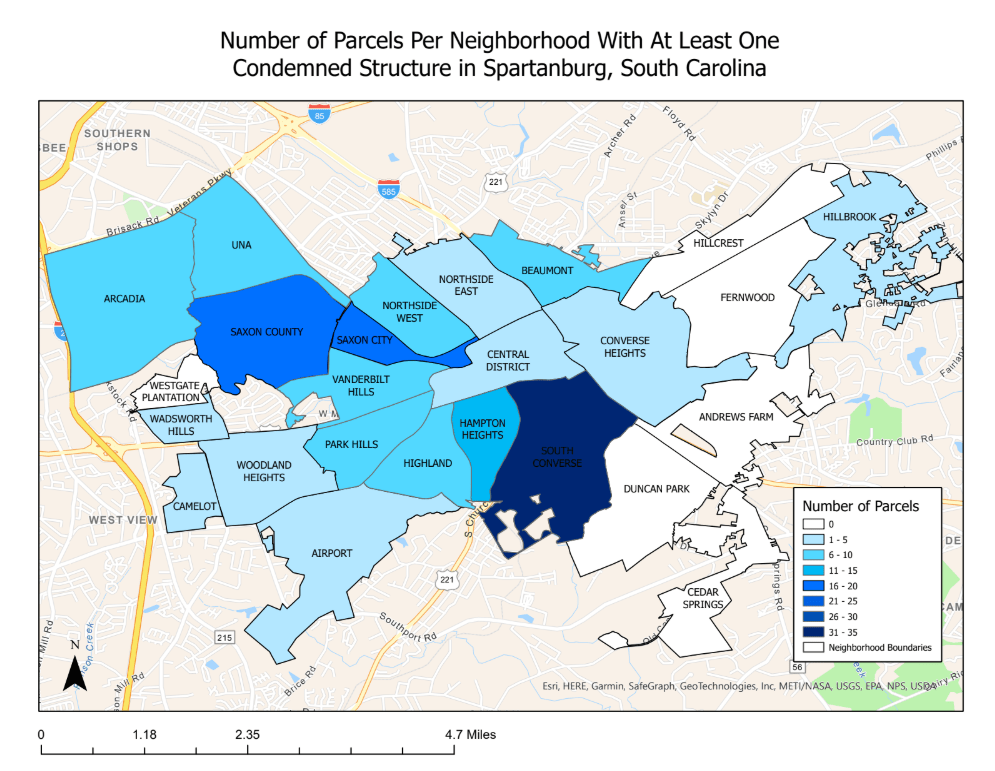
- Shows the total number of condemned properties in each neighborhood.
South Converse leads with 33 condemned properties, followed by Saxon County & Saxon City (16 each). - However, raw counts alone are not conclusive—larger populations or higher reporting rates may influence these numbers.

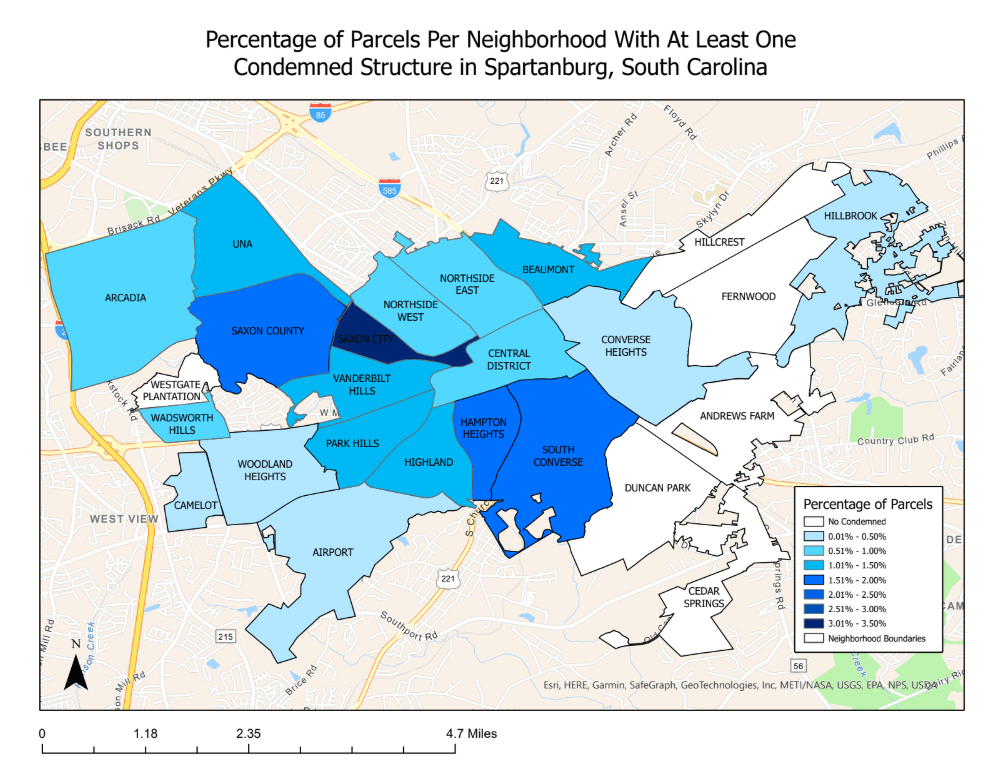
- Standardizes data by calculating the percentage of condemned properties per total parcels in each neighborhood.
- Saxon City has the highest rate (3 condemned parcels per 100), followed by Saxon County (1.8/100) and South Converse (1.63/100).
- Still, parcel sizes vary, meaning this method has limitations.

- Examines the number of condemned properties per square mile, accounting for neighborhood size differences.
- Saxon City ranks highest (43.82 condemned homes per square mile), followed by South Converse (19.40) and Highland (17.48).
Owner Analysis:
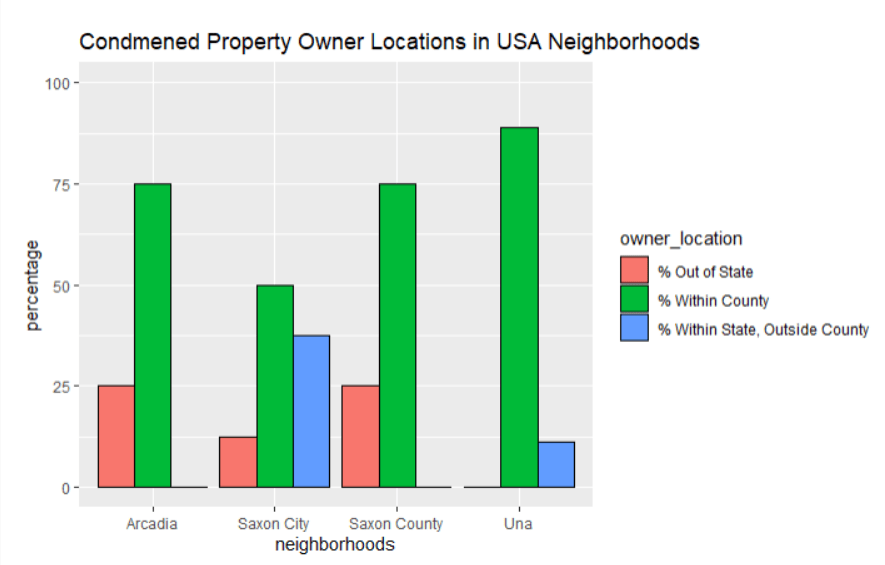
- Most condemned property owners reside within Spartanburg County, challenging the assumption that absentee landlords are a primary issue.
Limitations
- While the data provides valuable insight, further research is needed to determine if condemnation rates are disproportionate compared to factors like income levels, housing age, and enforcement policies.
- The findings do not outright disprove residents’ concerns but suggest a more complex picture that requires additional study.
Media
Post and Courier –
- Wofford abandoned homes study presented to Spartanburg County Council
- $1M in federal funds to tear down blighted properties
Fox Carolina News –
 Drew Wilson
Leave a comment