Introduction
This study examines inequitable access to grocery stores in Asheville, North Carolina, a city marked by socioeconomic divides, transportation limitations, and recent disruptions such as Hurricane Helene. While prior research has focused on qualitative accounts of food insecurity, little work has used spatial modeling at a fine geographic scale. This project fills that gap by applying a probabilistic Huff Model to estimate grocery store choice and accessibility at the census block–level, incorporating factors such as store attractiveness, distance, income-weighted demand, and store type.
Study Area
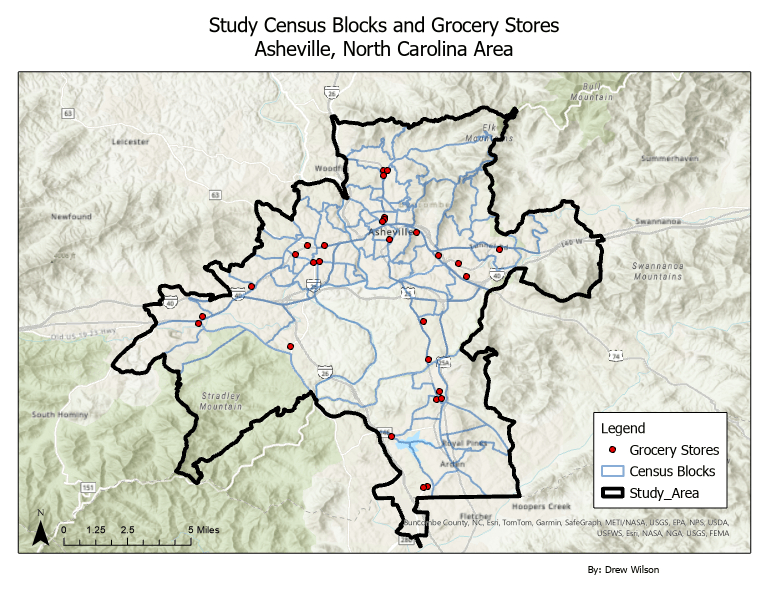
The study area includes the city of Asheville and adjacent census blocks within Buncombe County. Asheville’s irregular shape reflects its terrain-constrained growth pattern within the Blue Ridge Mountains. Development is limited on most sides except the south, where suburban expansion has occurred. Grocery store locations (from the 2023 ArcGIS Business Analyst POI dataset) and census blocks (TIGER/Line 2023) form the spatial foundation. Stores are categorized into three types, high-end, value, and discount, and analyzed in relation to surrounding population, income, and block-level geography.
Methodology

Spatial Interaction Model:
- Applied the Huff Model to predict the probability that residents shop at specific grocery stores
Demand Modeling:
- Calculated income-weighted population (median household income/ total population)
Store Categorization:
- Ran the model separately for high-end, value, and discount grocers.
Store Attractiveness Measure:
- Used sales volume as the attractiveness variable.
Distance Decay:
- Applied a distance decay exponent of 1.5.
Distance Calculation:
- Computed road-network distances between block group centroids and store locations.
Output Processing:
- Mapped probabilities, compared across store type, and evaluated in relation to demographic factors (income, car ownership).
| High-End Grocers |
| Whole Foods Market |
| The Fresh Market |
| Value Grocers |
| Harris Teeter |
| Publix Supermarkets |
| Ingles Markets |
| Discount Grocers |
| Aldi Markets |
| Sav-Mor Foods |
Results
The Huff Model results reveal strong spatial variations in grocery accessibility and store preference:
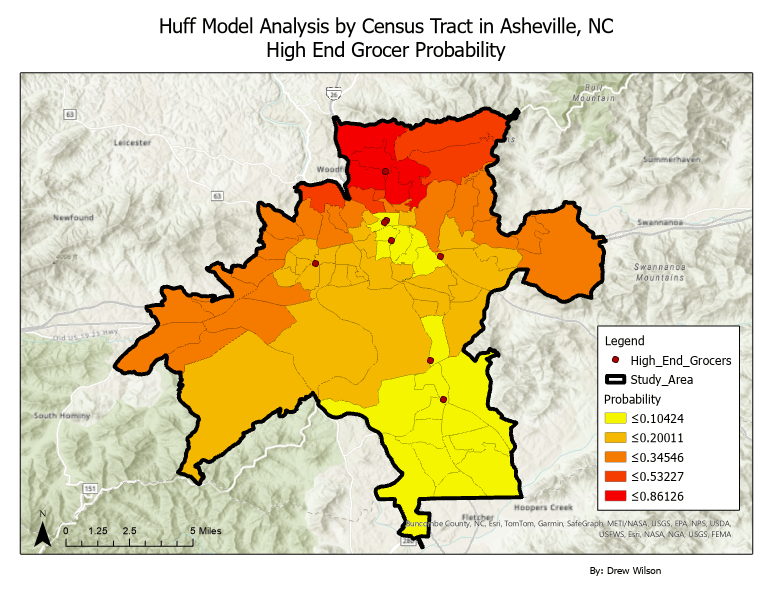
- High-End Grocers:
- Highest probabilities in North Asheville, including Lakeview Park (probability 0.86).
- Lowest probabilities downtown and in southern tracts, aligning with fewer high-end options and differing income levels.
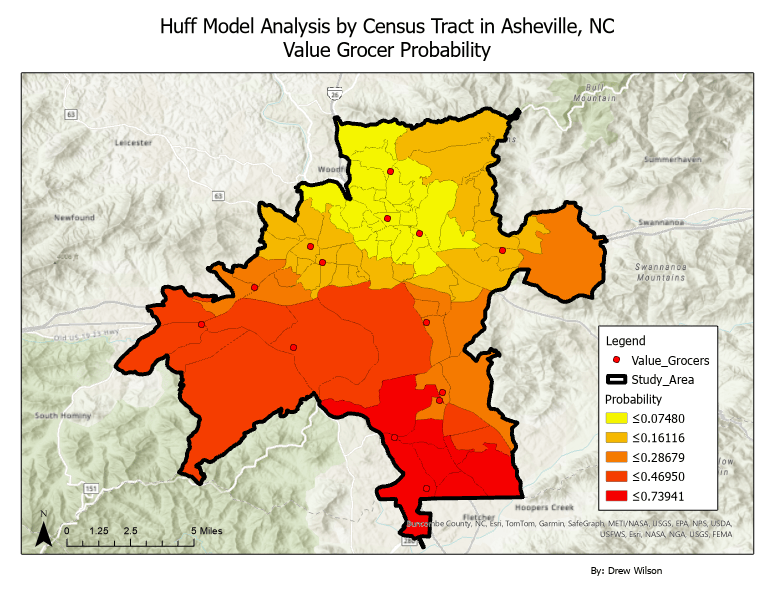
- Value Grocers:
- Strongest probabilities in southern and southwestern census blocks (Arden, Skyland, Candler).
- Driven largely by Ingles Markets’ dominance.
- Downtown shows low probabilities and low income—creating a mismatch between need and availability.
- Discount Grocers:
- Highest probabilities concentrated around Arden, where a single Aldi dominates due to sparse competition.
- Low probabilities elsewhere indicate a shortage of discount options citywide.

Key insights:
- South Asheville and surrounding suburbs show imbalance—high growth but limited high-end or discount options.
- Downtown lacks affordable grocers, creating barriers for lower-income, low-transportation households.
- Ingles Markets’ regional dominance makes many areas dependent on a small number of key stores, making communities vulnerable to disruptions—highlighted by the closure of the Swannanoa Ingles after flooding.
Discussion
This analysis highlights clear inequities in grocery access across Asheville. High-end stores cluster in wealthier northern neighborhoods, value stores dominate regionally, and discount grocers are limited and unevenly distributed, leaving central and lower-income neighborhoods underserved. Rapid development in the south and ongoing housing pressures further intensify disparities. The Huff Model results provide essential insight for planners and policymakers, revealing where new grocery investments, particularly discount or affordable options, could most improve equitable access. This spatial model offers a strong foundation for future planning efforts aimed at enhancing food security and community resilience.
 Drew Wilson