An Evaluation of Heatwaves and Mental Health Related Emergency Department Visits in North Carolina
Introduction
Implications of Mental Health:
- 1 Billion People have some form of mental health disorder 1
- $5 trillion dollars lost in economic activity just due to complications within this people group .
Implications of Extreme Heat:
- 1℃ increase in global temperature estimates reduction in economic growth by 8.5%
- Over $1 billion dollars is lost annually in the United States alone due to heat related complications
Hot temperatures lead to negative mental health effects .
(not heatwaves)
Few studies have evaluated the relationship between heatwaves and mental health. First of its kind study for NC can showcase vulnerabilities.
Study Area and Methods
Data:
- Sheps NC Emergency Department Visits
- NC Climate Data
- Spatial Resolution: ZCTA
Mental Health Definition:
- ICD10 Codes: F00 – F99
Study Period:
- Summer (May-September) 2016 – 2019
Heatwave Definition:
- Daily Mean Temp >= 95th percentile of the Mean 3 Day Temperature
Statistical Method:
- Linear Regression Models
Study Question:
- Do Number of Heatwave/ Non-Heatwave Days predict Mental Health Related Emergency Department visits controlled for by population?
Preliminary Data
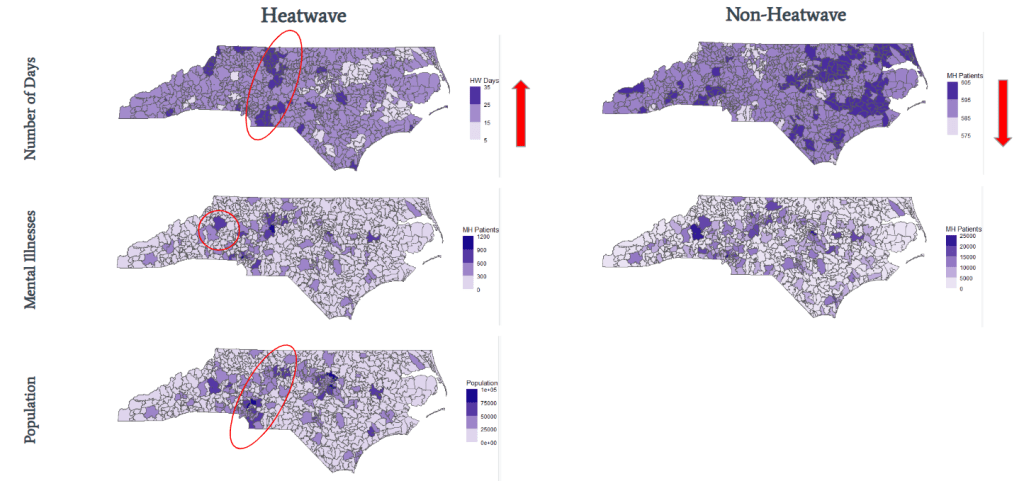
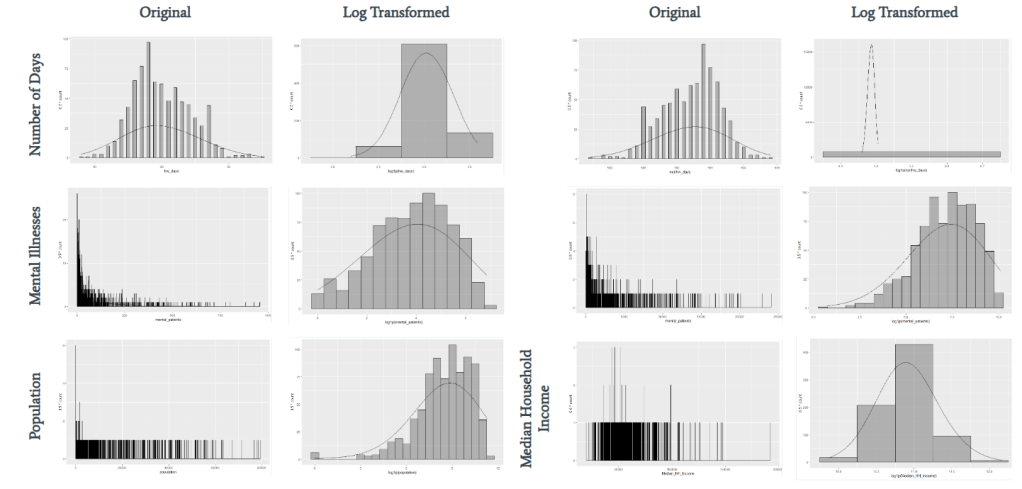
Linear Regression Models
Original Data Model
lm(Mental Health Patients ~ Number of Days + Population, data)
Log Transformed Data Model
lm(log1p(Mental Health Patients) ~ Number of Days + log1p(Population), data)
Model with Predictors
lm(log1p(Mental Health Patients) ~ Number of Days + log1p(Population) + log1p(Income) + log1p(Medicare/ Medicaid) + log1p(Racial Demographics), data)
Results
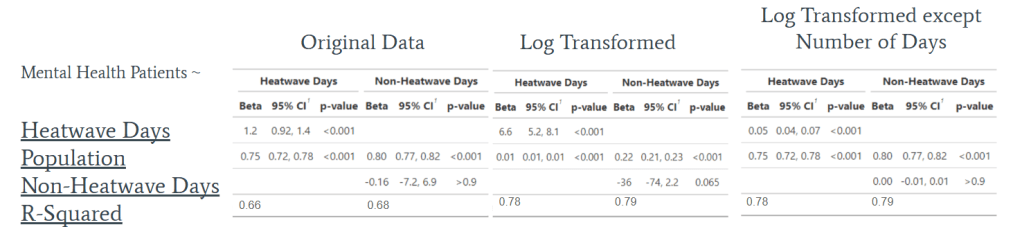

Discussion
Study Question:
- Do Number of Heatwave/ Non-Heatwave Days predict Mental Health Related Emergency Department visits controlled for by population and other socioeconomic factors?
Limitations:
- Limited data (just 4 years)
- Heatwave calculation definition
Further Research:
- More robust methods for the analysis – time series analysis, multiple regression
- More predictor variables such as age, mental health condition, rural/ urban
- Greater spatial area, entire United States
 Drew Wilson